Should Schools Post Photos of Students Online?
A guide to safeguarding, consent and safer alternatives for school leadership teams
LAST UPDATED: March 2026
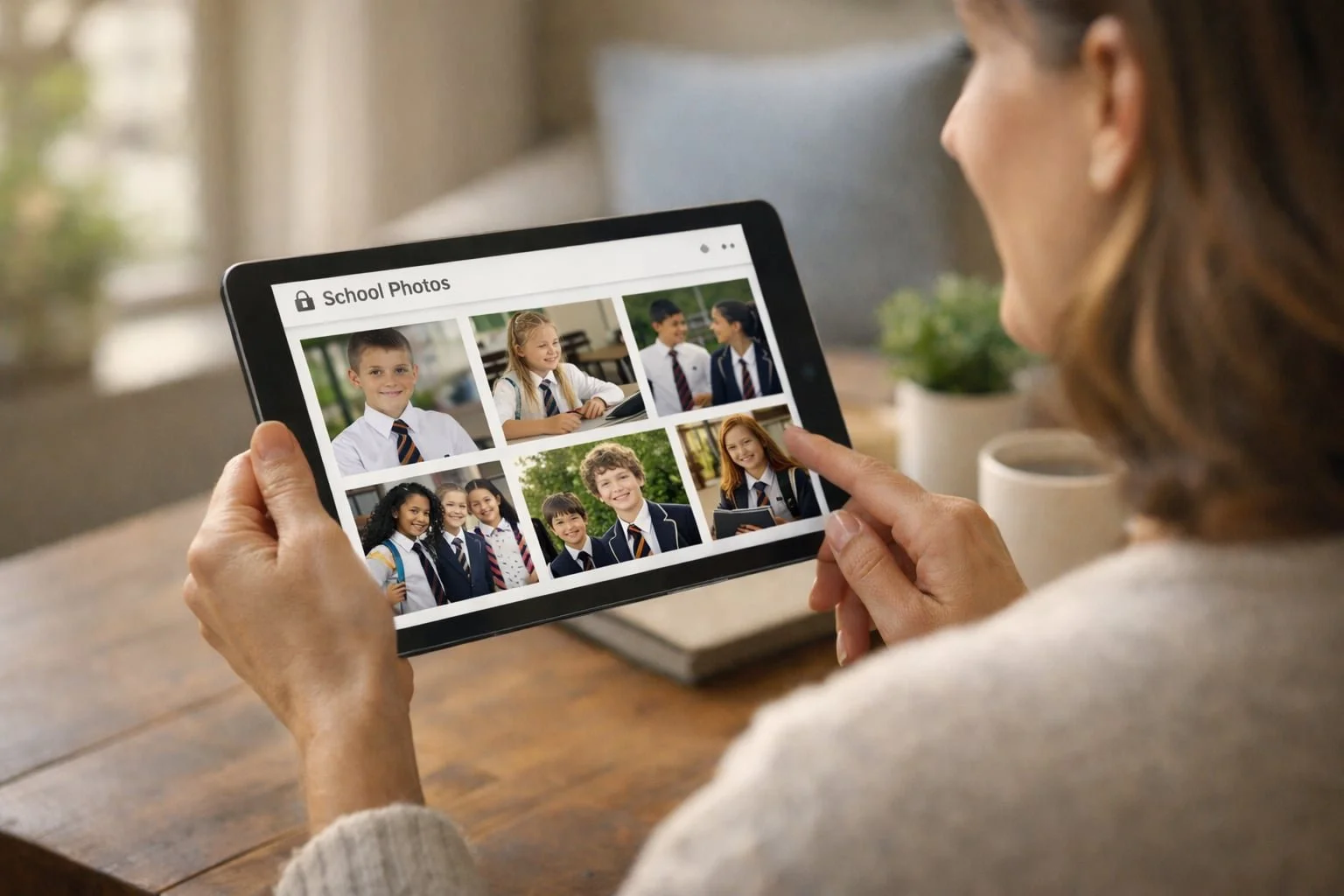
For many schools, sharing photographs of pupils has become a normal part of communication. Websites and social media feeds showcase school life, celebrate achievements, and help communities feel connected.
But a growing number of schools are beginning to reconsider how (and where) student images are shared.
Concerns around safeguarding, consent, digital footprints, and emerging risks such as artificial intelligence and deepfakes are prompting leadership teams to review long-standing practices. Some schools are now reducing identifiable pupil images on public platforms or moving towards more controlled environments instead.
This article explores why this shift is happening, the challenges schools face when managing pupil images, and what safer approaches to sharing might look like.
Why Schools Are Reviewing How Pupil Images Are Shared
Several factors are converging to create change.
Safeguarding responsibilities
Schools have always carried responsibility for protecting pupils. However, the digital environment has introduced new complexities.
Once an identifiable image is published online, schools often/usually cannot control:
Who downloads it
How it is reused
Where it is shared
How long it remains accessible
Guidance from the Independent Schools Council highlights this challenge clearly, noting that:
“It is impossible to make school websites secure and schools would be well advised to consider everything that it publishes… as beyond the school’s control in the public domain forever.”
The guidance also recognises that images published publicly are inherently vulnerable to misuse:
“There needs to be a certain acceptance that images can always be accessed and are liable to be used inappropriately if published publicly.”
This creates tension between community engagement and safeguarding obligations, particularly as schools seek to celebrate pupil achievements while protecting wellbeing.
Guidance from child protection organisations reinforces these concerns. The NSPCC notes that:
“Sharing photographs and images of children… carries potential risks,”
and warns that once images are online they may be:
“copied, downloaded, screenshotted or shared by anyone.”
These realities mean that decisions about pupil imagery are increasingly viewed through a safeguarding lens rather than purely a communications or marketing decision.
Digital footprint awareness
There is increasing recognition that children should have agency over their future digital identity. Images shared during childhood can remain searchable for decades.
Many schools are now considering:
Whether pupils should consent themselves (not just parents)
How images might affect pupils later in life
Whether permanent public exposure is appropriate
Artificial intelligence and deepfake risks
Advances in AI have changed the risk landscape significantly. Publicly available images can now be manipulated or repurposed in ways that were previously impossible.
Australian regulators have reported deepfake abuse incidents occurring in schools on a regular basis, highlighting how rapidly this risk is emerging.
Across safeguarding organisations there is a consistent message: images of children require careful management. Guidance from the NSPCC and the UK Safer Internet Centre emphasises consent, risk awareness, and appropriate controls when publishing images online, reflecting growing recognition that digital exposure forms part of a school’s safeguarding responsibility.
This has accelerated policy discussions globally.
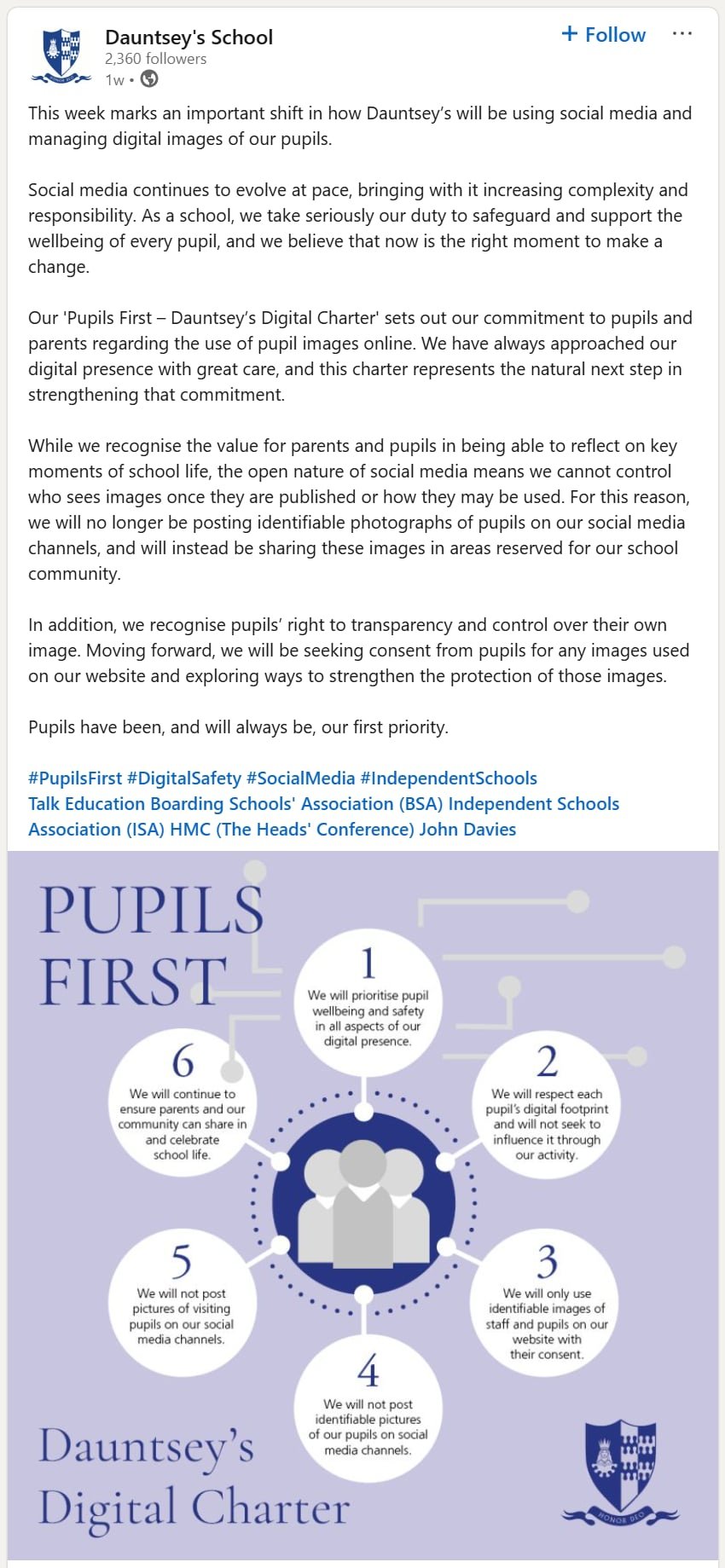
Screenshot of Dauntsey’s School’s LinkedIn post announcing its Pupils First Digital Charter and changes to sharing student photos online
Real Examples: Schools Changing Their Approach
Some schools are already adjusting policies in response to these concerns.
Schools requesting that parents do not post images of events on social media
Policies restricting identifiable pupil information alongside photographs
Opt-out lists for students who cannot appear in images
Consent processes requiring greater transparency
Moves toward secure parent portals rather than public posting
For example, St Hilda’s Anglican School for Girls in Australia recently announced it would remove identifiable student images from public social media channels, citing emerging digital risks and the need to prioritise student wellbeing. The school instead plans to use secure, password-protected galleries for families.
More recently, schools such as Dauntsey’s in the UK have gone further by publicly announcing a new ‘Pupil’s First’ Digital Charter committing to avoid posting identifiable pupil photos on social media entirely as well as recognising “pupils’ right to transparency and control over their own image.”
This reflects a broader shift toward controlled environments rather than open platforms and suggest a trend that is likely to grow over the coming years.
Is Asking Parents Not to Post on Social Media Enough?
Many schools attempt to manage risk by asking families not to share images publicly.
While well-intentioned, this approach has limitations.
Schools cannot realistically control:
Hundreds or thousands of parents
Extended family members
Screenshots and downloads
WhatsApp groups
Private accounts
Images shared beyond the immediate community
Even where policies exist, enforcement is largely dependent on voluntary compliance rather than technical control.
Even when parents comply, once images are widely distributed enforcement becomes difficult.
Ultimately, responsibility for safeguarding still sits with the school.
This gap between policy and practical control is one reason some schools are exploring alternative approaches.
The Operational Challenge: Managing Consent and Permissions
Beyond public posting, schools face complex operational challenges around pupil images.
Typical issues include:
Tracking which pupils have consent
Managing opt-outs across year groups
Trip and event photography
External photographers
Changes in consent over time
Staff awareness of restrictions
Storage of images across multiple systems
Requests for removal or deletion
Data protection guidance reinforces that identifiable photographs are usually considered personal data and must be used in line with consent.
As image volumes grow, the risk of accidental misuse increases.
What Safer Sharing Can Look Like
Importantly, reviewing photo sharing practices does not mean schools need to stop sharing photographs.
Families value seeing school life.
Pupils enjoy celebrating achievements.
Community connection matters.
The question is often not whether to share images, but how to do so safely.
Guidance from the Independent Schools Council also suggests that schools should consider publishing images in password-protected areas wherever possible, reflecting the importance of controlled access rather than fully public distribution.
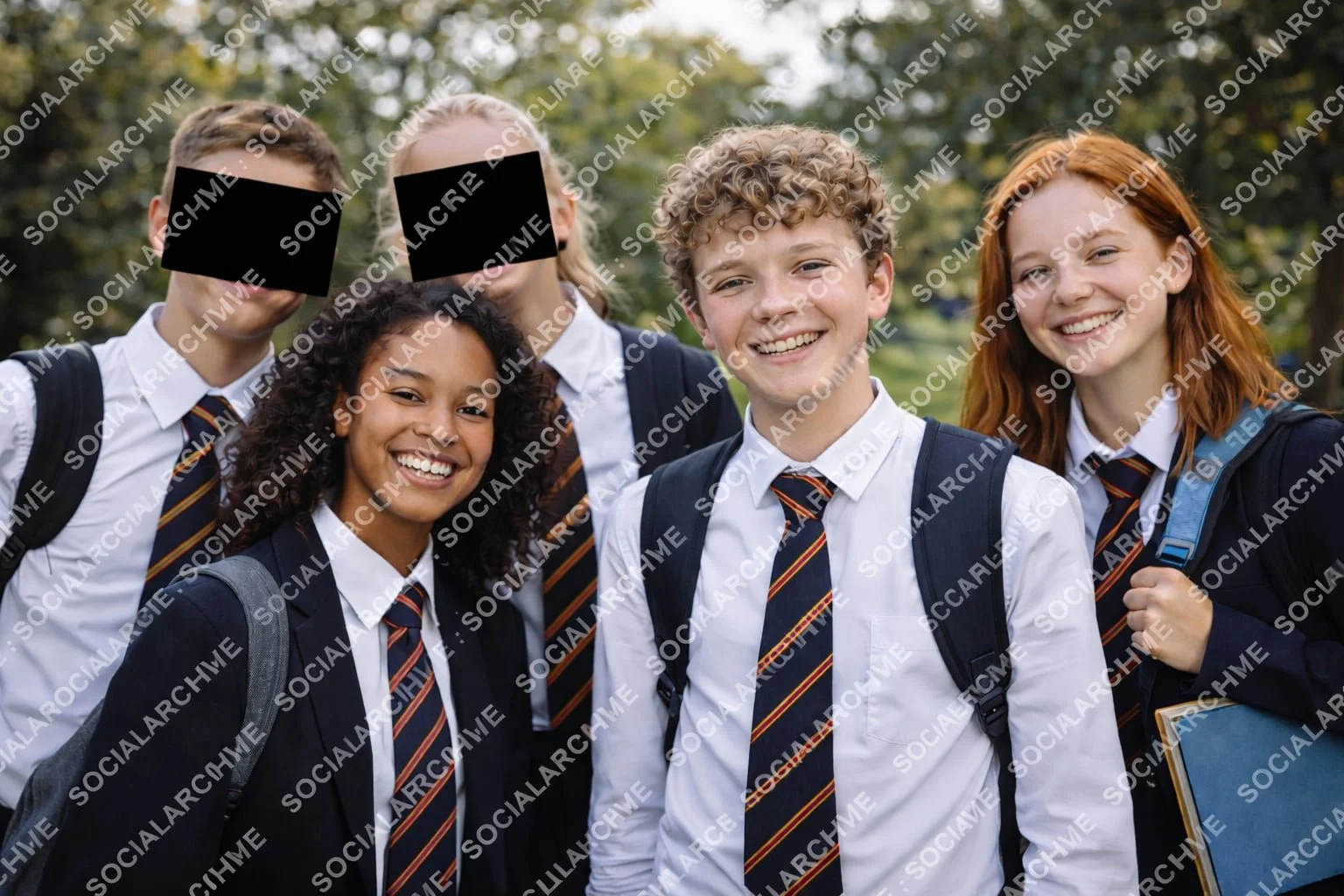
Secondary school student group photo with some faces redacted and watermark applied to demonstrate secure photo sharing and consent protection
Safer approaches may include:
Secure school-controlled platforms
Permission-based access for parents and pupils
Monitoring of downloads and usage
Watermarking of images
Clear consent tracking linked to individuals
Separate public and private content spaces
Controlled retention and storage policies
Some schools are beginning to explore private community environments where families can access relevant images without open public distribution.
Could Consent-Aware Image Sharing Be the Future?
Emerging technologies make more sophisticated approaches possible.
For example, systems could allow:
Parents to only download images of their own child
Automatic blurring or redaction of pupils without consent
Permission rules linked to pupil profiles
Schools retaining original unredacted versions securely
Audit trails showing who accessed images
Consent updates over time
These approaches align more closely with safeguarding responsibilities while still supporting community engagement.
The Role of Technology, Including Facial Recognition
Facial recognition can be controversial, but in a controlled school environment it may serve practical safeguarding purposes.
Used responsibly and with consent, it can help:
Identify pupils in images
Prevent accidental inclusion of restricted pupils
Enforce consent rules automatically
Manage large photo collections efficiently
Any use of such technology must be transparent, consent-based and aligned with data protection guidance.
In this context, the goal is not surveillance, but risk reduction and compliance.
Balancing Visibility and Protection
Schools still need visibility.
Marketing, admissions, community engagement, and storytelling all benefit from authentic images of school life.
The challenge is finding the balance between:
Celebrating community
Protecting pupils
Respecting consent
Maintaining control
Different schools will adopt different approaches depending on context, resources, and risk tolerance.
Questions for Schools Reviewing Their Image Policies

Leadership teams may find it helpful to consider:
Where are our pupil images currently stored?
Who has access to them?
How do we track consent?
Can we remove images if requested?
Are staff confident about permissions?
What risks exist if images are publicly downloadable?
Do families have a safe way to access photos?
Are our practices aligned with safeguarding expectations?
These questions are increasingly part of digital strategy discussions.
A Likely Direction for the Future
We are likely to see more schools adopting:
Clear digital image policies or charters
Consent-first approaches
Reduced identifiable public content
Secure community sharing environments
Structured photo management systems
The shift will be gradual, but the direction is becoming clearer.
Schools are not necessarily moving away from photography.
They are moving toward greater control.
As the digital environment evolves, safeguarding expectations and technological possibilities are evolving too.
For many schools, the key question is no longer:
Should we share pupil photos?
It is:
Where should they live, and who controls them?
Reviewing How Your School Shares Images?
If your school is currently reviewing how pupil photographs are managed, stored or shared, you are not alone. Many schools are reassessing their approach as safeguarding expectations, digital risks and technology continue to evolve.
SocialArchive provides a secure, school-controlled environment for photo sharing, where schools can:
Store photographs safely in a structured digital archive
Manage consent and permissions alongside images
Share photos privately with parents, pupils and staff
Monitor access and downloads
Watermarking of images to reduce the likelihood of them being misused
If you would like to explore what a more controlled approach to image sharing could look like for your school, you can contact us or book a short conversation here.
Further Guidance:
UK Safer Internet Centre — Managing Student Image and Video Content
Information Commissioner’s Office — Taking Photographs: Data Protection Advice for Schools
FAQs:
Is it safe for schools to post photos of students on social media?
Posting student photos on social media carries safeguarding and privacy risks because schools cannot control who downloads or shares images once they are public. Guidance from organisations such as the NSPCC and the Independent Schools Council highlights the importance of consent, risk awareness, and careful management when publishing identifiable pupil images online.
Do schools need consent to use student photos?
Yes. In most cases identifiable photographs of pupils are considered personal data under data protection law, meaning schools should obtain appropriate consent before using them. Schools should also be clear about how images will be used, where they will be published, and how long they will be retained.
What are the safeguarding risks of sharing pupil photos online?
Risks include unauthorised sharing, image manipulation, misuse by third parties, and loss of control over how images are distributed. Emerging technologies such as artificial intelligence and deepfakes have increased concern about how publicly available images might be repurposed.
Is asking parents not to post school photos on social media enough?
Policies asking parents not to share images can help reduce risk, but enforcement is difficult because schools cannot control how families distribute images once they are shared. Many schools are therefore exploring more controlled approaches to sharing photographs within secure environments.
What are safer alternatives to sharing school photos on social media?
Safer approaches may include secure, password-protected platforms where schools control access to images, manage consent permissions, and monitor downloads. Some schools are moving toward private community spaces rather than publishing identifiable pupil images publicly.
How can schools manage consent for student photos effectively?
Effective consent management involves maintaining accurate records, linking permissions to individual pupils, updating consent over time, and ensuring staff understand restrictions. Technology systems can help schools manage permissions alongside image storage to reduce the risk of accidental misuse.
Are schools moving away from posting student photos publicly?
Some schools are beginning to reduce identifiable pupil images on public platforms due to safeguarding concerns, digital footprint awareness, and AI-related risks. Instead, they are exploring controlled environments that allow families to access school photos safely while maintaining greater oversight.
Other articles that may be of interest: