School Archives: What Should You Digitise First?
LAST UPDATED: June 2026
Summary: Most schools are sitting on decades of history (photographs, VHS tapes, school magazines, year group records) and not enough time to tackle all of it. This practical guide helps schools and universities decide what to digitise first, with a free prioritisation matrix you can use with your team today, a 12-month roadmap, and a worked example showing the framework in action.
Most schools are sitting on decades of history. Year group photographs going back to the 1950s. Sports day programmes. Prize-giving records. Staff portraits. Issues of the school magazine that nobody has looked at in years. And somewhere, almost certainly, a box of early 2000s CD-ROMs that nobody is quite sure how to open.
Knowing you should be doing something with all of this is one thing. Knowing where to start is another.
The good news is that you do not need to tackle everything at once. You do not need a dedicated archivist, a six-figure budget, or a perfectly organised system before you begin. What you need is a clear sense of what to prioritise first, and why.
This guide gives you a practical framework for making those decisions, including a free scoring tool you can download and use with your team today.
Why Prioritisation Matters for Schools
Unlike a library or museum, a school archive is not purely about preservation. It is about people. The alumni who remember their first day. The parent who wants to show their child what the school looked like thirty years ago. The development office building a fundraising campaign around shared memories. The head of year putting together a leavers' video. The reunion coordinator tracking down photographs of the class of 1999.
That context changes everything about how you think about prioritisation.
Yes, some materials need digitising urgently because they are deteriorating. But some materials need digitising urgently because there is a 25th reunion in October, and the development office needs photographs of that cohort by September. Both are legitimate reasons to move something up the list.
A clear prioritisation strategy also helps you make the case internally. When a governor asks why the school is investing time in the archive, or when a member of staff wonders why this matters, a coherent plan is a far stronger answer than "we're just working through the boxes."
The School Archives and Records Association (SARA) (whose membership spans over 440 state and independent schools across the UK) provides professional guidance and resources for anyone managing a school archive, and is a useful starting point for teams building their approach from scratch.
Our complete guide to school digital archives covers the broader picture of building and sustaining a school archive. This article focuses specifically on the question of where to start.
Five Criteria for Prioritising Your School's Digitisation Work
Condition & fragility
Uniqueness & irreplaceability
Alumni engagement & reunion potential
Engagement & storytelling potential
Accessibility & findability
Condition & fragility
Uniqueness & irreplaceability
Alumni engagement & reunion potential
Engagement & storytelling potential
Accessibility & findability
These five criteria work best when used together. A collection that scores well across several of them is a strong candidate for early digitisation. One that scores highly on only one can wait.
1. Condition and Fragility
Some of your materials are deteriorating right now. Photographic prints fade. Magnetic media (VHS tapes, early digital camera memory cards, those CD-ROMs) degrades. Newsprint yellows and becomes brittle. Once the content is gone, it is gone.
This is the most urgent case for digitisation, even if the materials involved are not the most publicly exciting items in the collection. A VHS of the 1994 school play may not feel like a priority until it becomes unplayable and the moment is lost forever.
The early 2000s memory gap is particularly relevant here. Many schools have strong photographic records up to the late 1990s, and again from the mid-2000s onwards but the transition years are often almost entirely undocumented, and the alumni who lived through them are now in their thirties and forties.
Questions to ask:
Is this item visibly deteriorating?
Is it stored somewhere that is accelerating the damage?
If it were lost tomorrow, would the content be gone forever?
2. Uniqueness and Irreplaceability
Some items in your collection exist nowhere else. The original school photograph from 1962. The handwritten letter from a founder. A staff portrait from the year the school moved to its current site. These are irreplaceable, and their loss would be permanent.
Other materials (published textbooks, widely distributed magazines, standard government correspondence), may be held by other institutions and can reasonably be deprioritised.
Questions to ask:
Does this item exist anywhere else?
If our copy were lost, would the content survive?
3. Alumni Engagement and Reunion Potential
This is the criterion that makes school archives genuinely different from other heritage collections.
If you have a cohort celebrating their 25th or 50th reunion this year, the photographs, records and stories from their time at school should move straight to the top of your list. A digitised, searchable collection from those years gives your alumni relations and development team something tangible to work with (personalised content, reunion displays, fundraising campaign material, memory triggers that reconnect alumni with the school at exactly the right moment).
The same logic applies to any significant anniversary, admissions campaign, or development push. Digitising strategically around these moments multiplies the return on the time invested.
Questions to ask:
Do we have a reunion, anniversary or development campaign coming up that these materials could support?
Which cohorts are we trying to re-engage right now?
4. Engagement and Storytelling Potential
Not all materials are equally useful once digitised. A ledger of exam results is historically significant but offers limited engagement for most of your community. A collection of year group photographs, sports day images, school play programmes or handwritten notes from a beloved teacher carries inherent storytelling potential. It is shareable, discussable, and far more likely to prompt a response.
This does not mean ignoring historically important but less visually engaging material. It means being realistic about what will actually generate engagement, contributions and connection when it goes online, and prioritising accordingly (especially when resources are limited).
Questions to ask:
Once this is online, will alumni recognise themselves or people they know?
Could it power a social media post, a reunion display, an admissions story?
Does it have the kind of visual or human quality that makes people stop and look?
5. Accessibility and Findability
There is little value in digitising materials that then sit in an unorganised folder that nobody can search or navigate. Before committing to a digitisation phase, consider how the resulting files will be described, tagged and made accessible. Materials that are straightforward to label with names, years and events are better candidates for early digitisation than complex collections that require specialist knowledge to describe usefully.
A platform that allows alumni to identify people in photographs, add their own memories and search by name or year group transforms a collection of files into something genuinely alive.
Questions to ask:
Can we tag this material in a way that makes it searchable?
Can alumni help identify people or add context?
Will it be findable by the people it matters to most?
The Prioritisation Matrix
Use this matrix to score your collections before deciding which to tackle first. Score each criterion from 1 to 3, then total the scores.
Stable, good storage
Some deterioration
Actively deteriorating
Held elsewhere
Partially unique
Unique to this collection
No upcoming hooks
Some campaign relevance
Reunion or campaign tie-in
Primarily administrative
Mixed formats
Strong visual or personal
Complex to tag
Moderate effort
Easy to tag with names & years
Score interpretation
No scoring tool replaces professional judgement. Use this as a starting framework and adjust it to reflect your school's specific priorities and community.
Download the free prioritisation matrix
To make this easier to apply to your own collections, we have created a free Excel tool you can download and use straight away. Enter your collections in the inventory tab and they pull through automatically into the scoring matrix. Score each one using the dropdown menus, add an urgent flag for anything that needs to jump the queue regardless of its score, and the tool calculates your priority phases which you can then use to populate a 12-month roadmap. (We discuss the 12 month digitisation roadmap in more depth further in the article).
Seeing the Matrix in Action: A Worked Example
A prep school is sitting on four main collections: a run of annual school photographs going back to 1958, a set of VHS recordings of school plays from the 1980s and 1990s, physical copies of the school magazine from 1965 to 2010, and a box of administrative correspondence from the school's founding decade.
They also have a cohort celebrating their 40th reunion in six months.
Applying the matrix, the VHS recordings and the school photographs from the reunion cohort's years score highest. The VHS tapes are deteriorating (some are already showing signs of magnetic decay) and the content exists nowhere else. The school play recordings from the reunion cohort's years in particular score maximum points across condition, uniqueness and alumni engagement potential.
The photographs from the reunion years score equally highly on engagement and findability — they can be tagged with year, names and events, and will be immediately recognisable to returning alumni.
The school magazine run is unique and valuable but stable, and can follow in phase two. The administrative correspondence from the founding decade is historically significant but scores low on engagement and alumni relevance — it goes to phase three.
The VHS tapes and reunion-era photographs become phase one. Everything else follows.
The matrix did not make the decision. But it gave the school a clear, defensible rationale for the order they chose.
The Role of Alumni in Deciding What Matters
Your alumni community is one of the most valuable resources you have when it comes to prioritisation, not just as an audience, but as a source of intelligence.
Alumni know which years feel underrepresented. They know which events and traditions matter most to people. They know which photographs people have been trying to find for decades. A simple online form or a question in your next alumni newsletter, "what would you most like to see in the archive?" will tell you more about where to focus than any internal audit.
Once materials are online, alumni who can identify people in photographs, add stories and share memories become active contributors to the quality of the collection. That participation is also one of the most reliable drivers of ongoing alumni engagement.
How Volunteers Can Help
For many schools, time is the real barrier. The intention is there. What's missing is the capacity to work through them.
Volunteers are one of the most overlooked resources in school archiving. St Peter's School, York is a good example, they used a university student volunteer to accelerate their archive project significantly, at no cost and with surprisingly little management overhead. The student brought not just time but genuine enthusiasm for the material, and the school built a sustainable model where each volunteer helps onboard the next.
Alumni volunteers are another underused resource. Former pupils with an interest in history, photography or the school's heritage can often be recruited through your alumni network. They bring existing knowledge of the collection (people, places, events), that makes their contribution far more valuable than a general volunteer with no institutional connection.
Scanning, tagging, identifying people in photographs, writing captions, helping to organise physical materials before digitisation… All of these are tasks that volunteers can take on with straightforward guidance and the right platform behind them.
A 12-Month Digitisation Roadmap for Schools
A 12-month roadmap does not need to be complicated. Its purpose is to make your intentions concrete, create accountability, and give you something to share with governors, your head or your development office when they ask what the archive project actually involves. Use the priority phases from the matrix to populate it, and build your reunion and campaign dates in from the start, so digitisation efforts are timed to deliver maximum impact.
A Note on "Good Enough"
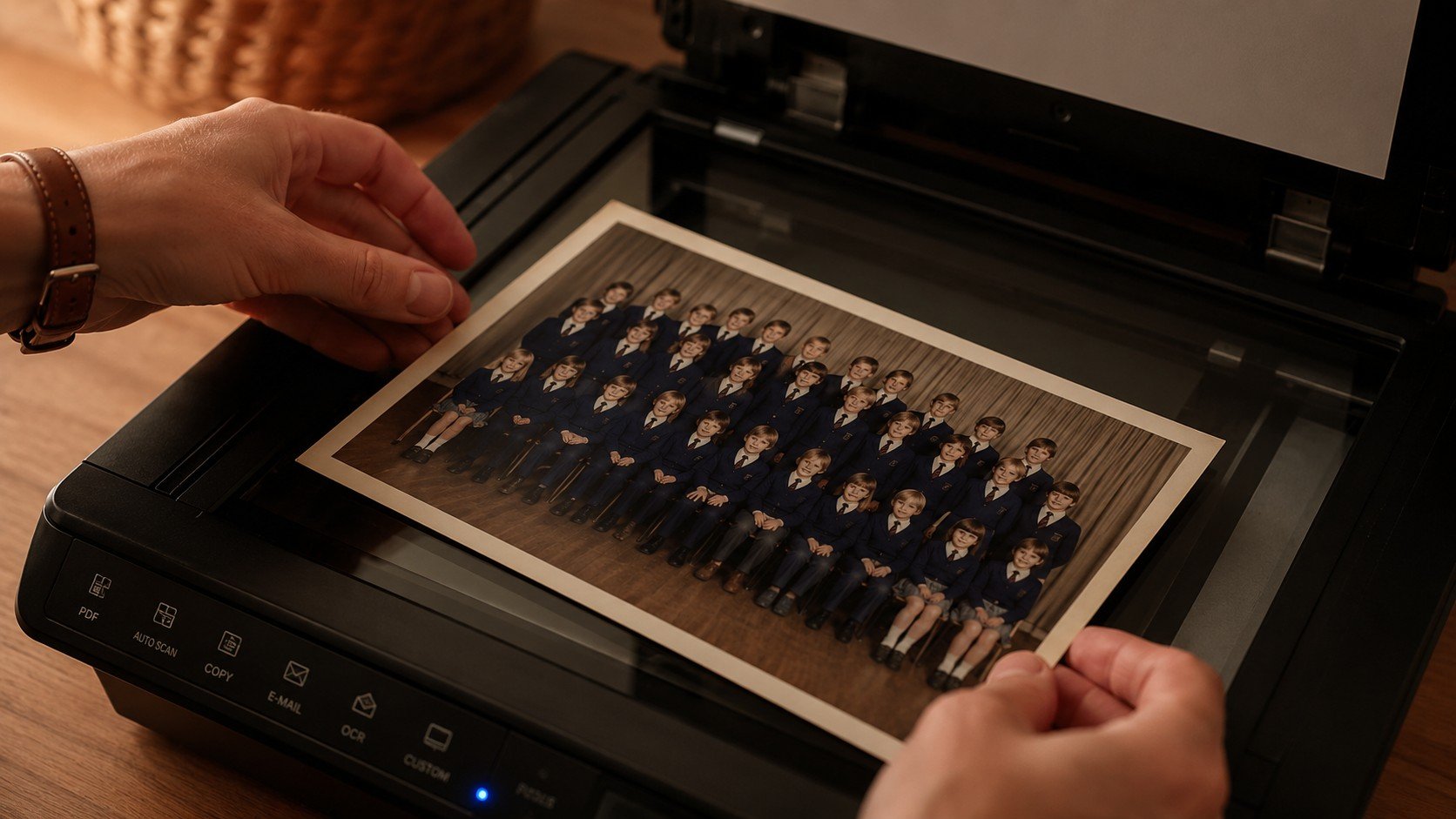
You do not need professional scanning equipment to make meaningful progress. A decent flatbed scanner or even a modern smartphone camera is adequate for most photographic prints and documents.
The DPI standards that matter: 400 DPI minimum for photographic prints, 300 DPI for text documents. The National Archives' digitisation guidance is the authoritative UK reference point for technical standards (the early sections in particular are accessible and practical for non-specialist teams).
What matters more than technical perfection is consistency. Agree on a file naming convention before you start and stick to it. A file called 1987_sports_day_year9_relay.jpg is infinitely more useful than scan0047.jpg.
And do not wait until the system is perfect before you publish. An adequately tagged photograph that alumni can find and identify is worth more than a perfectly catalogued item that sits unseen on a shared drive.
If you are still working out how to get your archive off the ground before you reach the digitisation stage, our guide to starting a digital archive at your school without an archivist covers the practical first steps in detail.
Where to Start
The schools that make the most progress with their archives are the ones that picked something concrete to start with and got it online.
Choose one collection. Apply the matrix. Start with what scores highest. Get it in front of your alumni and your wider community.
The first batch you publish will teach you more about what your community values, what they remember, and what they want to see next, than any amount of internal planning. It will also build the momentum and internal support that makes everything else easier.
Your alumni are waiting to recognise themselves. Start with whatever is most likely to give them that moment.
SocialArchive helps schools, colleges and universities build digital archives that connect alumni, support fundraising and preserve the stories that matter. Find out how SocialArchive can help by contacting us or booking a short demo here.
FAQs:
What should a school digitise first?
Start with materials that score highest across five criteria: condition and fragility, uniqueness, alumni engagement potential, storytelling value, and findability. For most schools this means at-risk materials such as VHS recordings and early digital media, combined with photographs and records tied to upcoming reunions or development campaigns.
How do you prioritise a school archive when you have limited time and staff?
Use a simple scoring matrix that assesses each collection or batch against five criteria rather than individual items. Group your holdings into broad categories (photographs, video, print publications, administrative records) and score each category as a whole. This gives you a clear phase order without needing to assess every item before you begin.
Do you need professional equipment to start digitising a school archive?
No. A flatbed scanner or modern smartphone camera is adequate for most photographic prints and documents. Aim for 400 DPI minimum for photographic prints and 300 DPI for text documents. Consistency in file naming and metadata matters more than technical perfection.
How can a school archive support alumni engagement and fundraising?
Digitising collections strategically around reunion years, anniversaries and development campaigns gives your alumni relations and fundraising teams powerful, personalised content to work with. A searchable archive that alumni can explore, contribute to and share is one of the most effective tools for building lasting connection and inspiring generosity.
Other articles that may be of interest: