How to Share Photos of School Life Securely: A Practical Guide for Schools
LAST UPDATED: September 2026
Schools do not need to stop photographing school life. But as more schools reconsider posting identifiable pupil photos publicly, they do need better ways to share those images with the people who matter.
Across the UK and internationally, more schools are making the decision to reduce, or even stop, sharing identifiable photographs of pupils on public websites and social media.
It is an understandable response to a changing digital landscape. Concerns around safeguarding, children’s digital footprints, AI image manipulation and the simple reality that a publicly posted photograph can be downloaded, copied and redistributed have prompted schools to reconsider practices that, until recently, felt entirely routine.
But deciding what not to do is only half the answer.
Schools still take thousands of photographs. Parents still want to see the sports days, productions, trips, concerts and everyday moments that make up their children’s school lives. Alumni and wider school communities still value the photographs and stories that keep them connected.
So, if those images are no longer going onto Instagram, Facebook or a public school website, where should they go instead?
We have previously looked in detail at whether schools should post photographs of pupils online, including the safeguarding, consent and emerging AI risks behind the debate. This guide focuses on what comes next: practical ways schools can continue capturing and sharing school life while keeping greater control over who can see, access and use those images.
Why Schools Are Rethinking How They Share Student Photos
The conversation around school photography has moved quickly, and it is not limited to one country.
Schools in the UK, Australia and elsewhere are reconsidering long-established approaches to sharing identifiable student images publicly, prompted by concerns around safeguarding, children's digital footprints and the growing possibilities for AI-powered image manipulation.
In May 2026, updated image-security guidance was issued to schools in the UK following reports of criminals taking photographs of pupils from school websites and social media and using AI tools to manipulate them. The UK Safer Internet Centre reported that police had sought help from the Internet Watch Foundation after images sourced from a secondary school’s online presence were altered to create abusive material.
The same month, reporting in The Guardian highlighted calls from child-safety experts for schools to reconsider identifiable pupil photographs on public websites and social media. It also reported that Loughborough Schools Foundation had redesigned its website to remove recognisable images of pupils.
This does not mean every school will reach the same conclusion about public photography. Policies, safeguarding requirements and privacy laws vary between countries and individual schools.
What it does mean is that where and how photographs are shared deserves much more deliberate consideration than it once did.
For UK schools, the Department for Education's guidance on taking, using and sharing photos and videos in schools provides useful guidance around how images are used, stored and shared. Schools elsewhere should, of course, consider the privacy, safeguarding and consent requirements that apply within their own jurisdiction.
But the practical question is remarkably similar wherever a school is based: how can we continue to share and celebrate school life without making every photograph available to the open internet?
For schools deciding that public social media or their publicly facing website should no longer be the default home for school photography, here are eight practical steps to consider.
1. Decide Which School Photos Actually Need to Be Public
The first step is deciding who actually needs to see each type of content.
For many years, school photography has effectively had two settings: published or unpublished.
That distinction is increasingly inadequate.
A photograph intended to promote the school to prospective families has a different audience from photographs of Year 8 sports day. An image from a 1980s school archive has different considerations from photographs taken on yesterday’s residential trip.
Instead, schools can begin thinking in terms of different levels of visibility.
Public content might include carefully selected admissions photography, buildings and facilities, staff, historic material where appropriate, and non-identifiable images of school life.
Community content might include performances, sports days, assemblies, trips and celebrations that parents, pupils and other approved members of the school community would value seeing.
Restricted content might only be appropriate for particular year groups, teams, clubs, classes or other defined groups.
This changes the starting question from:
“Can we post this photograph?”
to:
“Who does this photograph need to be available to?”
That is a much more useful way to approach image sharing.
Public
Open to anyone, anywhere. Should never include identifiable current pupils.
- Admissions photography
- Buildings & facilities
- Staff photography
- Non-identifying school life shots
Community
Available to the whole school community, but not the open internet.
- Performances & productions
- Sports days & assemblies
- Trips & celebrations
- Whole-school events
Restricted
Only appropriate for a specific, defined group.
- A single year group
- A team or club
- An individual class
- Pupils with safeguarding restrictions
2. Give Parents a Secure Alternative to Social Media
Simply stopping public photography creates another problem if families have nowhere else to see school life.
Parents still want the photograph of their child crossing the finish line on sports day. They want photographs from the school production they couldn’t attend, the geography trip, prize giving and the ordinary moments their children rarely tell them about at home.
If the school does not provide those photographs, informal alternatives inevitably become more attractive: WhatsApp groups, parents’ own photographs, screenshots and images passed between families.
A better approach is to give the community a school-controlled place to access school photography.
That could be an existing parent platform or a dedicated secure school photo-sharing environment such as SocialArchive.
The important distinction is between an image being online and being publicly available online.
A photograph stored within an authenticated environment, with appropriate access controls and policies governing its use, is very different from the same photograph being indexed on a public website or placed on an open social media account.
The objective is not necessarily to share fewer photographs. It is to share them with the right people.
3. Control Who Can See Different School Photo Galleries
A password-protected platform is a useful starting point, but schools can go further.
Consider a Year 7 residential trip.
Does every member of the school community need access to those photographs? Probably not. Could access instead be limited to the parents, pupils and staff connected with that year group?
Or could it be more personalised still, with parents only able to access photographs in which their own child appears?
Likewise, an alumni reunion gallery might appropriately be available to former pupils but have no relevance to current parents.
Schools can therefore consider permission-based access at gallery or collection level, rather than simply placing every private image behind the same login.
For example:
| Year 9 families |
Whole community |
Alumni | Public | |
|---|---|---|---|---|
| Year 9 Sports Day | ||||
| School Production | ||||
| Old Scholars' Reunion | ||||
| 1975 Archive |
Year 9 Sports Day
Visible to: Year 9 families
School Production
Visible to: whole school community
Old Scholars' Reunion
Visible to: alumni community
1975 Archive
Visible to: alumni community, public
SocialArchive allows schools to create public, private and permission-controlled areas within the same digital environment. Different audiences can therefore experience different parts of the school’s story without everything needing to be made publicly accessible.
For schools with large communities, this distinction becomes particularly important.
Security is not simply about having a password. It is about giving the right people access to the right content.
4. Build Photo Consent and Permissions Into the Process
For many schools, the biggest difficulty is not taking photographs. It is knowing what they are allowed to do with them afterwards.
A single event can contain students with different requirements. One family may be comfortable with photographs appearing in the school newsletter but not on social media. Another student may have safeguarding restrictions that mean they should not be publicly identifiable. Permissions may also change during a student's time at the school.
Privacy, consent and data-protection requirements vary between jurisdictions, but the practical challenge is much the same: staff need to know what permissions or restrictions apply before an image is shared.
For UK schools, the Department for Education says schools should check restrictions before using, storing or sharing images and should not publish pupils who should not be publicly identified, including where safeguarding concerns or court orders apply. Where consent is the lawful basis, schools must also maintain appropriate records.
There is also an important distinction that can sometimes get lost in discussions about school photography. Under UK data-protection law, consent is one possible lawful basis for processing images, but it is not the only one. Schools need to determine the appropriate lawful basis for the particular use and be transparent about it.
The Information Commissioner's Office guidance on taking photographs in schools provides further practical guidance for UK schools. Schools elsewhere should follow the privacy and consent requirements applicable in their own country or region.
Whatever the school's legal basis and policy, the operational challenge remains the same.
Can the member of staff uploading Tuesday’s photographs easily tell what restrictions apply?
If the answer relies on remembering an email, checking a spreadsheet or asking somebody in another department, mistakes become much easier to make.
A more robust process brings image permissions and restrictions closer to the images and individuals themselves.
SocialArchive can help schools manage permissions alongside their photographic collections, making it easier to control how images are made available rather than treating consent management and photo management as two entirely separate tasks.
5. Have a Process for Students Who Cannot Appear in Shared Images
Imagine a photograph from a school production.
It captures 30 pupils on stage and perfectly sums up the evening. But one pupil in the photograph should not appear in the version shared with the wider community.
Does the school abandon the entire photograph?
Does somebody crop the image?
Does a member of the communications team manually blur the pupil?
Or does the restriction simply get missed?
This is where the technology available to schools can start to change the workflow.
SocialArchive’s redaction and safeguarding tools can help protect pupils who should not appear in shared imagery. Rather than relying entirely on staff to identify and manually alter individual photographs, redaction can be used to mask individuals from versions made available to relevant audiences.
What families see
Shared version of the school production photo
Redacted
What's kept in the archive
Original photo, restricted-access only
Importantly, redaction does not need to destroy or permanently alter the source material. The original can remain appropriately protected within the school’s controlled archive while a redacted version is used where necessary.
This is particularly valuable as school image collections grow.
A restriction affecting one pupil may potentially affect dozens or hundreds of photographs across sports days, trips, concerts, classroom activities and events.
The ability to apply restrictions systematically is much more scalable than relying on somebody remembering every photograph in which that pupil appears.
6. Think About What Happens After Someone Views a Photo
A login controls who gets through the front door.
Schools should also think about what happens once someone is inside.
Should every photograph be downloadable?
Does a parent need access to the original full-resolution file?
Would a lower-resolution image be sufficient?
Should certain photographs carry a watermark?
Can the school control which material can be downloaded?
SocialArchive provides schools with controls including audience download restrictions, watermarking and redaction, which can be applied at different levels within the archive.
Watermarks will not make an image impossible to misuse. Nor can any platform completely prevent somebody from photographing or capturing what appears on their screen.
That should not be the promise.
Instead, measures such as controlled access, download restrictions and watermarking create additional layers of protection and reduce the ease with which high-quality school imagery can be taken and redistributed without context.
This is a useful principle for schools reviewing their systems generally:
Do not only ask who can see an image. Ask what they can do with it once they have seen it.
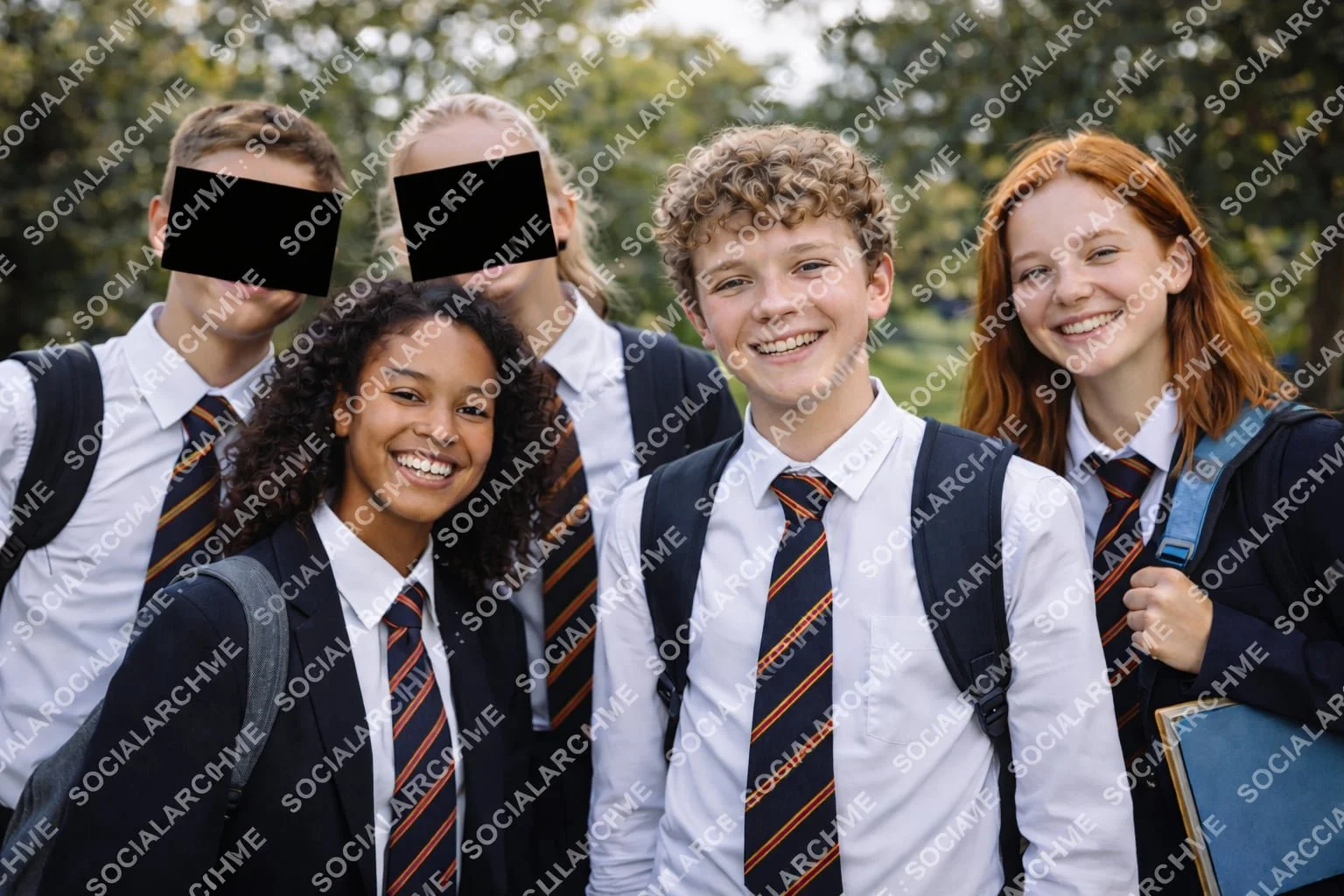
Watermarking and download restrictions work together with redaction, applied at whatever level within the archive a photo needs.
7. Set Clear Rules for Parents Taking Photos at School Events
Secure school photography is only one part of the picture.
There may be 300+ parents carrying smartphones at sports day.
Schools therefore need a clear approach to photography by parents, carers and visitors as well.
The ICO’s guidance for parents and schools on photographs explains that data protection law generally does not apply when parents take photographs for purely personal or household purposes. Schools can, however, establish their own photography policies for safeguarding and child-protection reasons. Public sharing of photographs containing other pupils can raise different considerations.
The DfE similarly recommends that schools explain expectations in their photo and video policy and remind parents and carers of the rules before significant events such as performances and sports days.
The NSPCC’s guidance on photographing and filming children also recommends having clear procedures around taking, sharing, using and storing images of children, recognising the safeguarding risks that can arise when appropriate processes are not in place.
Schools might therefore consider practical instructions such as:
“Photography is permitted for personal use, but please do not publicly share photographs containing other pupils. Official photographs from today’s event will be made available through the school’s secure gallery.”
The second sentence is arguably as important as the first.
It gives families an alternative.
If parents know that good-quality official photographs will be available securely afterwards, there may be less pressure to capture, upload and circulate everything themselves.
8. Audit the School Photos You Have Already Published
Changing your policy today does not change what you published yesterday.
If your school decides that identifiable current-pupil photographs should no longer be freely available online, it is worth reviewing the digital footprint that already exists.
That might include:
school website news articles
old website galleries
Instagram, Facebook, LinkedIn or other social accounts
sports pages
departmental websites
old blogs
YouTube videos and thumbnails
online newsletters
third-party platforms
archived campaign pages
downloadable PDFs and prospectuses
This does not necessarily mean deleting every historical photograph.
Instead, schools should consider whether older material remains appropriate under their current policies, safeguarding responsibilities and stated purposes for using the images.
The UK Safer Internet Centre’s image-security advice includes regular auditing of children’s images across websites, social media and promotional materials as one of the measures schools can take in response to emerging risks.
An annual image audit could therefore become a useful part of a school’s wider safeguarding, communications and data-protection review.
Where This Leaves Public Photo Sharing
None of this means giving up on celebrating school life publicly. Open days, sports days, concerts and results days are still worth sharing, and a carefully chosen, non-identifying image on a prospectus, website or social post can still play an important role in admissions and community engagement.
What has changed is the range of options available.
A photograph no longer has to sit at either extreme: hidden away entirely or available to the whole internet. It can be public, community-only, restricted to a particular group, watermarked, downloadable or not, and redacted where necessary.
The important shift is away from assuming that every photograph taken needs to be published on an open platform to have value.
SocialArchive's marketing, admissions and communications tools are designed around that more controlled approach. Schools can use role-based permissions and different access levels to determine who sees particular content, restrict downloads, apply watermarks and use redaction where pupils should not appear in shared imagery.
It gives schools a way to keep their communities connected to school life while making more deliberate decisions about where photographs are shared, who can access them and what they can do with them afterwards.
If your school is somewhere between "we know we need to change this" and "we're not sure where to start", get in touch to talk through what a more controlled approach could look like for your setting. Alternatively you can book a call using the button below.
Before You Share Your Next School Photo: A 10-Point Checklist
Before publishing or sharing a photograph of pupils, consider:
FAQs
Can schools share photos of students with parents?
Yes. Schools can share student photographs with parents, but they should consider the privacy and consent requirements that apply in their jurisdiction, any safeguarding restrictions and who actually needs access. Using a secure, controlled environment can allow schools to share photographs with relevant families without making them publicly available online.
What is the safest way to share school photos with parents?
There is no single approach that will suit every school, but greater control can be achieved by using a secure, authenticated platform rather than public social media or website galleries. Schools can also consider restricting access by year group or individual, limiting downloads, applying watermarks and redacting pupils who should not appear in shared images.
Is a password-protected photo gallery safe for school photos?
Password protection can provide an additional layer of security, but schools should consider more than whether a gallery requires a login. Ideally, access should be limited according to who actually needs to see the content. For example, photographs from a Year 8 trip might only be available to relevant families rather than every user of the school portal.
Do schools need parental consent to share pupil photos?
The requirements vary depending on where the school is based, how the photograph will be used and the applicable privacy and data-protection laws. Schools should establish the appropriate consent, permissions or other legal basis for taking and sharing student images, be transparent with families about how photographs will be used and take account of any safeguarding or privacy restrictions that apply. In the UK, consent is one possible lawful basis for processing personal data, but it is not the only one.
How can schools share group photos if one pupil cannot appear?
Schools do not necessarily need to discard an otherwise useful group photograph. Depending on the circumstances, the relevant pupil can be cropped or redacted from the version being shared. SocialArchive's redaction tools can help schools manage this more systematically while allowing the original image to remain appropriately protected within the school's archive.
Should schools stop posting pupil photos on social media?
There is no universal rule requiring every school to stop posting pupil photographs publicly. However, growing concerns around safeguarding, children's digital footprints and AI image manipulation are leading some schools to reduce or stop sharing identifiable pupil images on public websites and social media. Schools reviewing their approach should consider whether an image genuinely needs to be public or whether it could be shared more appropriately within a controlled community environment.
Other articles that may be of interest: