LAST UPDATED: November 2026
School magazines have moved online, but their content hasn't always changed. With growing concerns about pupil privacy, AI and safeguarding, is it time for schools to rethink how and where they share them?

For decades, the school magazine had a quiet exception built into it.
While schools have traditionally been cautious about publishing identifiable photographs of pupils, the school magazine was different. It was a celebration of school life, filled with team photographs, prize winners, form groups, leavers' names and achievements. And it was produced primarily for the school community: pupils, parents, staff and former pupils.
Then the magazine moved online.
To save on print and postage, many schools now publish it as a PDF or flipbook on their public website. The format changed. The content mostly didn't.
But the audience changed completely.
What was once distributed to a relatively small, known community became available to anyone with an internet connection. Photographs, full names, year groups and achievements, all gathered in one publicly accessible document.
And that raises a question many schools are only now beginning to consider: should all of that information still be publicly available?
What's Changed?
This year, the risk to published school photographs stopped being theoretical.
Police sought help from the Internet Watch Foundation after images taken from a secondary school's online presence were manipulated with AI to create abusive material, and updated image-security guidance was issued to UK schools (UK Safer Internet Centre).
Child-safety experts are now urging schools to reconsider identifiable pupil photographs on public websites and social media (The Guardian).
The wider picture is moving fast. In the first half of 2026 alone, the IWF assessed 6,310 AI-generated images that met the legal definition of child sexual abuse, approximately 40% more than its total for the whole of 2025 (Irish Examiner).
School websites are also known to be a source of material collected for AI training. When Human Rights Watch examined a major AI training dataset, it found photographs of Australian children, some of them scraped from school websites (AAP).
Guidance is catching up. The UK Safer Internet Centre, working with the Early Warning Working Group, advises schools to audit their online images, keep names and images apart, and restrict public access by using password-protected platforms (UK Safer Internet Centre)
A publicly accessible school magazine brings several of these concerns together: recognisable faces, full names, year groups and the school's name, often gathered in one downloadable document.
For the wider debate on pupil images, see Should Schools Post Photos of Students Online?
It's About Words as Well as Pictures
Most of the conversation so far has focused on photographs. School magazines raise a second issue.
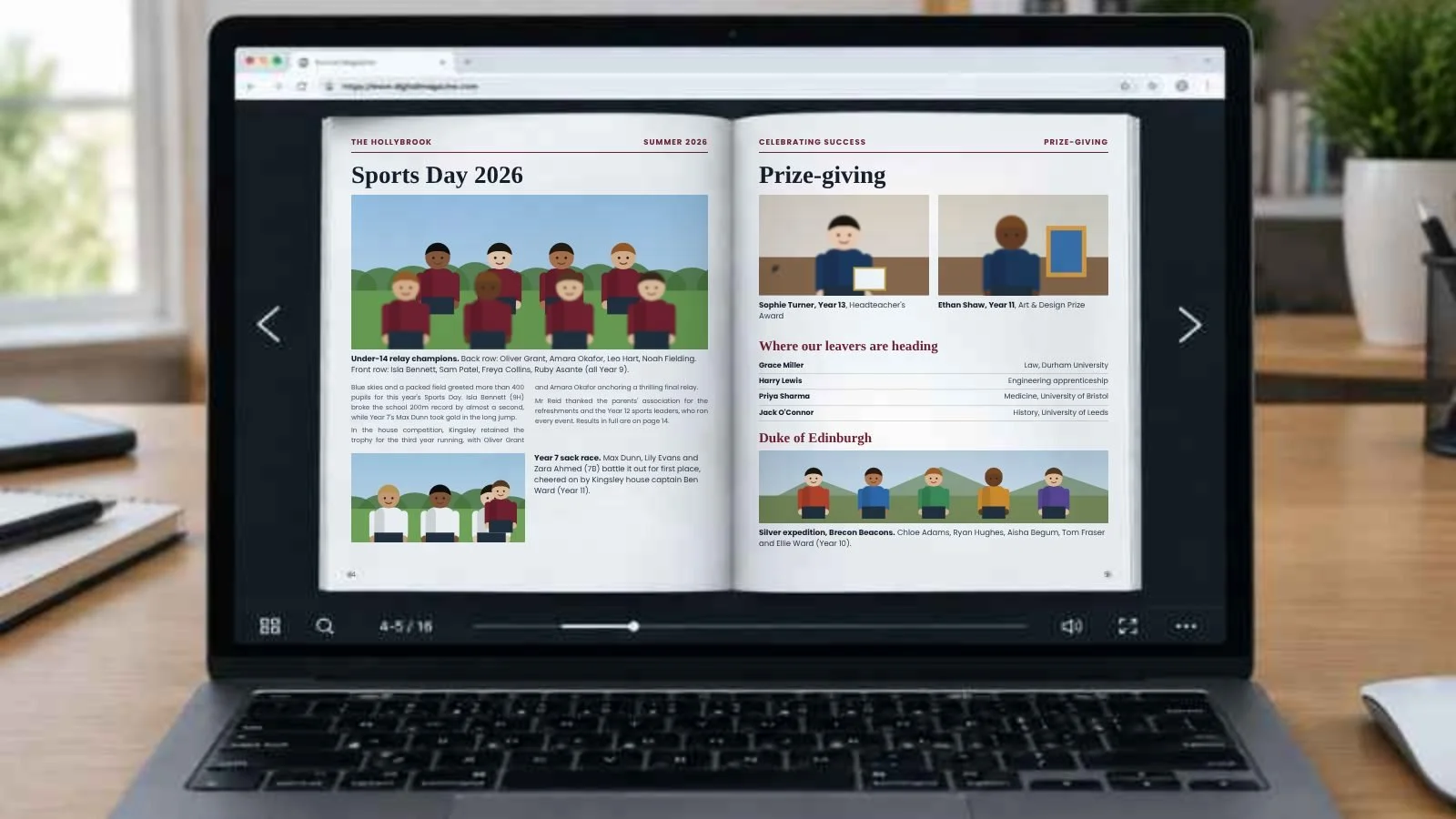
Illustrative image created with AI. In keeping with the subject of this article, no real pupils, names or school publications have been used.
Search engines can index public PDFs, and automated web crawlers can collect their contents, including crawlers gathering data for AI training.
A typical school magazine names pupils, their year groups, clubs, sporting achievements and sometimes where they're heading after school. Even without a single photograph, that's a substantial amount of personal information linked to a specific school, in a document anyone can download, copy and retain.
These are separate concerns. A photograph can be misused without ever appearing in an AI training dataset, while text collected by automated crawlers raises its own questions about how information about pupils may be stored, reproduced and reused.
Schools can use website settings to ask AI crawlers to stay away, but compliance is voluntary. These measures also do nothing to prevent someone deliberately downloading or harvesting publicly available content.
Then there are the back issues.
A magazine from 2015, still sitting on an old page of the school website, may contain photographs and identifying information about people who were children at the time and are now adults. They may have little awareness that those details remain publicly accessible.
For schools with decades of digitised magazines, this presents a significant challenge.
Why Schools Hesitate
There are good reasons the school magazine went public in the first place.
It's one of the best marketing tools a school has. Prospective parents read it to get a feel for school life, and alumni read it to stay connected. Pupils are proud to see their achievements celebrated, and many families share it with grandparents and friends.
Taking it off the website can feel like hiding the best of the school.
Putting it behind a login isn't a perfect answer either. Passwords get shared, pages get screenshotted and downloaded content can be redistributed. Paper copies were never entirely risk-free, since anyone could scan one and post it online.
But there is a meaningful difference between information that someone could share and information a school makes freely accessible, searchable and downloadable by default.
The goal isn't to lock everything away. It's to make better decisions about what should be public, what belongs within the school community and what needs to be preserved with more carefully managed access.
That's where the magazine's role starts to change.
Shop Window, Common Room, Archive
SocialArchive's guide to sharing school photos securely suggests thinking about images in terms of who needs to see them.
The magazine benefits from the same thinking, with one extra question: what happens to an issue years after it’s published? Pupils leave, consent changes and circumstances shift, so something that was fine to share in 2015 may not be today.
Rather than treating every edition as a single document intended for everyone, schools can think about magazine content in three distinct ways.
1. The Shop Window: Public Website
For prospective families and the wider world.
A carefully edited selection of stories, achievements, staff perspectives and school news, using photographs and identifying details that have been assessed as appropriate for unrestricted public access.
A shorter public highlights edition can continue to showcase school life without publishing the full magazine.
2. The Common Room: Logged-In Community
For current families, pupils, staff and authorised alumni.
The full magazine is shared within a controlled environment, with access permissions reflecting the intended audience, relevant safeguarding restrictions and the school's data protection policies.
Pupils can still see their achievements celebrated. Families can enjoy the photographs and stories. Former pupils can revisit their school days without every detail being publicly searchable.
3. The Archive: Permanent, Controlled Access
Every past issue, digitised and searchable, with access managed according to the school's requirements.
Historical magazines remain part of the school's institutional memory, but that doesn't mean every page needs to be available to every visitor.
Where necessary, identifiable individuals or sensitive information can be redacted from versions shared with particular audiences, while the original records remain protected within the archive, subject to appropriate retention policies.
The school magazine becomes a collection rather than a single document: the same history, shared differently depending on who is reading it.
Public website
Shop Window
Who it's for
Prospective families and the wider world
What goes in it
- A short highlights edition
- Stories, achievements and alumni features
- Photos where pupils can't be identified
Names and faces
One or the other, never bothLogged-in community
Common Room
Who it's for
Current families, pupils, staff and alumni
What goes in it
- The full magazine, every page
- Team photos, prize lists and leavers' news
- Event photos and house news
Names and faces
Together, where consent is givenPermanent record
Archive
Who it's for
Access set by role, now and in years to come
What goes in it
- Every past issue, digitised
- Fully searchable, page by page
- Back issues reviewed before wider sharing
Names and faces
Redacted from shared versions when consent changesA School Rethinking Public Access: Hutchesons' Grammar School
Some schools are already putting this approach into practice.
Hutchesons' Grammar School in Glasgow is moving its school magazine away from the public website and into its SocialArchive digital archive, where access can be controlled.
The decision reflects an important distinction. The magazine remains a valuable record of school life, and families and former pupils should still be able to enjoy it. But that doesn't necessarily mean the photographs and names of pupils need to be accessible to everyone on the internet.
The school isn't abandoning its magazine or removing its history. It's reconsidering how that history should be shared.
Other schools are taking a broader approach to public-facing photographs. Loughborough Schools Foundation, for example, redesigned its website to remove recognisable images of pupils (The Guardian).
These are different responses to the same underlying question: how can schools continue celebrating pupil achievement without making more personal information publicly available than necessary?
What Schools Can Do Now
Schools don't necessarily need to redesign their magazine or change their publishing arrangements overnight. A few practical steps can help establish where the greatest risks lie.
1. Audit what's already public
Search Google using “site:yourschool.com filetype:pdf” to identify magazines, newsletters and other PDFs that may still be publicly accessible.
Check older pages, archived news sections and previous versions of the website. Some publications may have been forgotten long after they stopped being promoted.
2. Review flipbook and PDF settings
Many digital publishing platforms offer settings for search indexing, downloads and social sharing, but schools may not realise how publicly accessible their magazines actually are.
If you use Issuu or a similar platform, check whether past editions are set to public. On some platforms, this means they can also appear in the platform's own search results and discovery pages. Setting a publication to 'unlisted' may remove it from those listings, but anyone with the link can still view it. If that link is embedded on your school website, the magazine remains publicly accessible.
Check whether downloads are enabled too, and whether publications can be accessed directly without visiting the school website.
Remember that removing a link doesn't necessarily remove the underlying file. Schools may also need to delete publicly hosted copies and request that search engines remove outdated results.
3. Consider a public highlights edition
Rather than publishing the full magazine, create a shorter edition specifically for the public website.
This could include school news, achievements, staff interviews, alumni stories and carefully selected photography.
The aim is to preserve the magazine's marketing value without automatically publishing the same level of personal information intended for families and the school community.
4. Move the full magazine into a controlled environment
Consider whether the complete edition would be better shared through a secure school portal or digital archive.
Access can then be managed for current families, staff, pupils and alumni, rather than being available to anyone visiting the website.
A login isn't a guarantee against redistribution, but it provides a more appropriate starting point for managing access.
5. Review photography permissions and privacy notices
Make sure the school's policies clearly explain how magazine content will be used, who can access it and whether it will appear publicly or within a restricted community.
Schools should also ensure that their approach reflects the appropriate lawful basis for processing personal data, as well as any safeguarding restrictions.
Consent may be relevant, but it is not the only lawful basis, and obtaining consent does not remove the need to assess whether a particular use of an image is appropriate.
6. Agree a policy for back issues
Historical magazines deserve particular attention.
Decide who should be able to access them, whether older editions need different permissions and how requests to restrict or remove personal information will be handled.
A pupil who appeared in several magazines may subsequently become subject to safeguarding restrictions, or a former pupil may raise concerns about information published years earlier.
Schools need a practical way to respond without necessarily losing the entire historical record.
7. Review how access will change over time
The audience for a magazine doesn't remain static.
Today's pupils become tomorrow's alumni. Families leave the school community. Permissions and safeguarding circumstances may change.
A sustainable approach should allow schools to review and adjust access over time, rather than making a single publication decision that remains in place indefinitely.
8. Reduce unnecessary information in public editions
Where photographs remain public, remove unnecessary embedded metadata and consider whether lower-resolution images are sufficient for the intended purpose.
These measures may reduce some forms of information exposure, but they don't prevent images from being copied or misused.
The more important question is whether a particular image or piece of identifying information needs to be publicly available in the first place.
Where SocialArchive Fits
SocialArchive gives schools a secure home for the “Common Room” and the “Archive”.
Magazines, newsletters and photographs can sit together within a controlled digital environment, with permission-based access determining which collections are available to families, pupils, staff and alumni.
Text recognition keeps historical editions searchable, from a 1987 sports report to last term's drama review.
Redaction is particularly important for school magazines.
A single edition can include hundreds of pupils, and some of them may need to be excluded from versions shared with particular audiences: a pupil with a safeguarding restriction, a family whose permissions have changed, or a former pupil who has requested that their information is no longer made available.
Removing the entire magazine would mean losing access to the record for everyone else. Editing individual pages by hand becomes increasingly impractical across decades of publications.
SocialArchive's redaction tools allow schools to mask individuals in the versions made available to different audiences, while retaining the original within the protected archive, where appropriate under the school's retention policies.
Archive original
Seen by authorised archive staff
The HollybrookSummer 2026
Sports Day 2026
Under-14 relay champions. Back row: Oliver Grant, Amara Okafor, Leo Hart, Noah Fielding. Front row: Isla Bennett, Sam Patel, Freya Collins, Ruby Asante (all Year 9).
Shared version
Seen by families and alumni
The HollybrookSummer 2026
Sports Day 2026
Under-14 relay champions. Back row: Oliver Grant, Amara Okafor, Leo Hart, Noah Fielding. Front row: Isla Bennett, Sam Patel, , Ruby Asante (all Year 9).
Nothing is deleted. Only what's shared changes.
Watermarking and download restrictions provide additional safeguards, helping schools manage how content is shared and reused. These controls cannot eliminate the possibility of screenshots or redistribution, but they offer more protection than unrestricted public access.
Selected galleries and content can still be made public for the “Shop Window”, allowing schools to continue celebrating achievements and sharing their stories with prospective families.
The result is a more flexible approach to school publishing: one that recognises the value of the magazine while giving schools greater control over how its contents are accessed.
The Magazine Goes Home
The school magazine still has an important role to play. It celebrates achievement, records school life and gives pupils, families and former pupils a shared record of their time together.
But publishing a magazine online is not the same as distributing it to a known school community. The audience is different, the risks are different, and the way schools manage access needs to reflect that.
Moving the full magazine into a controlled digital environment doesn't diminish its value. It gives schools a way to preserve every edition, make decades of history searchable and continue sharing those memories with the people they matter to.
The public website keeps the stories. The school community keeps the memories.
If your school is rethinking where its magazine lives, book a short call using the button below to see how SocialArchive could help.
FAQs:
Is it safe to publish school magazines online?
Publishing school magazines online isn't automatically unsafe, but schools should consider what personal information they contain and who can access it. Public PDFs featuring identifiable pupil photographs, full names and year groups may present greater privacy and safeguarding concerns than publications shared within a controlled school community. Schools should assess the content, intended audience and relevant data protection requirements before publishing.
Can AI tools access photographs and names in school magazine PDFs?
Yes. Publicly accessible PDFs can be discovered by search engines and collected by automated web crawlers, including those gathering data for AI training. Photographs and text may also be downloaded and reused independently. Restricting access to authorised users can reduce public exposure, although no system can entirely prevent someone with access from copying content.
Should schools remove old magazines from their websites?
Schools should review publicly accessible back issues, particularly those containing identifiable photographs and personal information about former pupils. This doesn't necessarily mean deleting the magazines. Moving them into a controlled digital archive can preserve their historical value while allowing schools to manage access, respond to safeguarding concerns and apply appropriate restrictions.
How can schools share digital magazines securely with parents and alumni?
Schools can use a secure digital archive or community platform, such as SocialArchive, that supports authenticated access, role-based permissions and controls over downloads and sharing. Additional features such as redaction and watermarking can help manage sensitive content. This allows schools to continue sharing full magazines with authorised families and alumni without making every edition freely available on the public internet.
Other articles that may be of interest: